
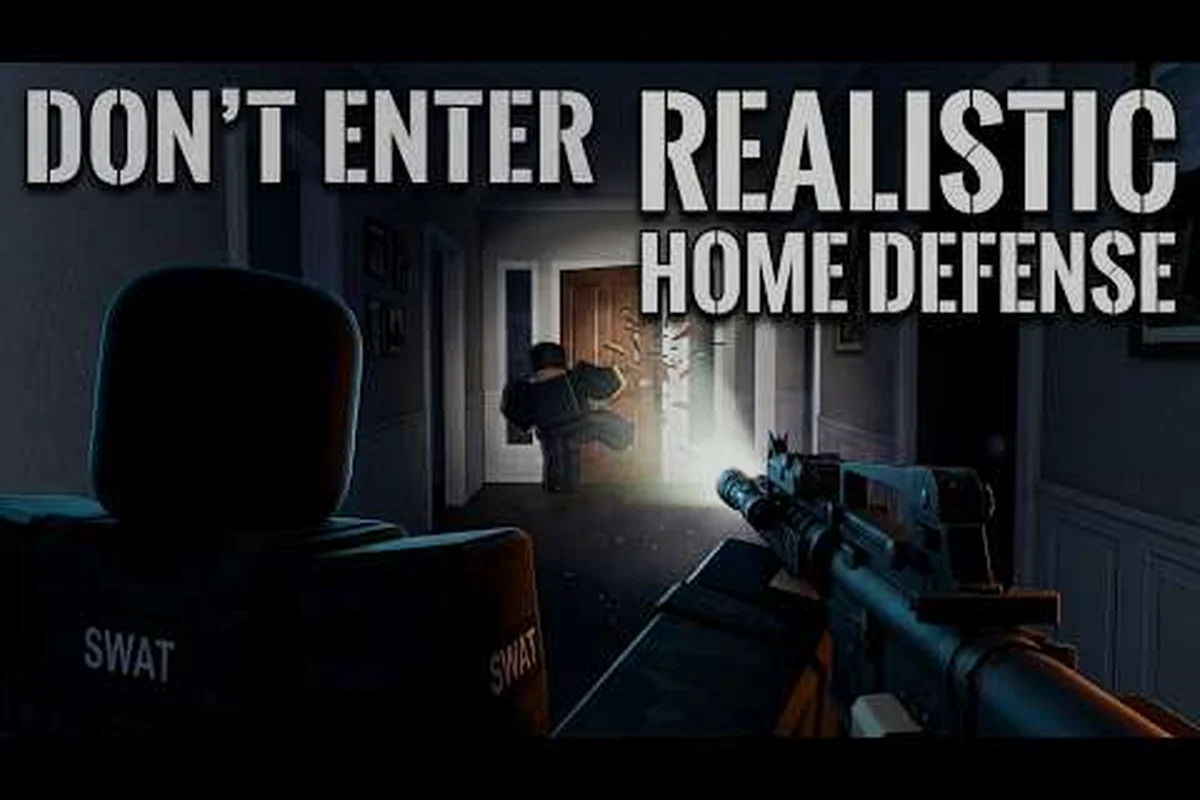
REALISTIC HOME DEFENSE is a first-person tactical shooter on Roblox where recoil-heavy guns, slow movement, and tight house layouts punish anyone who treats it like a run-and-gun arcade match. This realistic home defense game explained breakdown covers the core loop, the cash multipliers, and the habits that keep you alive.
The reason it matters: understanding the money system and the movement model early turns a frustrating deathmatch into a winnable round-by-round grind. Cash multipliers scale with consecutive round wins, so a single greedy push that gets you killed resets your streak and hands the defending team an economy lead they can snowball into better armor and weapons. Meanwhile, the slow movement model means sprinting across an open hallway is a death sentence — you commit to a lane, hold an angle near a doorway, and let the recoil-heavy guns reward patience over flick shots. Learn these two systems and every round becomes a calculated trade rather than a coin flip.
How a REALISTIC HOME DEFENSE Round Is Structured
The game comes from the IBA Community group and carries a Deathmatch Shooter label, but the round structure is closer to a home-invasion standoff than a free-for-all. According to the official REALISTIC HOME DEFENSE page, the experience centers on realistic weapon mechanics, tactical movement, and close-quarters home-defense action. Every round asks the same question: do you hold an angle, or do you push?
Here is how a typical round flows from spawn to finish, and the timing matters more than raw aim: each round opens with a loadout pick where you commit to a weapon before seeing how the lobby plays, then a short positioning window where the first player to lock a sightline on the main entry usually controls the pace. Because ammo is limited and there is no armor cushion, a single over-peek in the opening seconds can end your round before the first trade — which is why experienced defenders treat the spawn phase as a decision point, not a shopping trip.
-
Spawn and loadout — you pick a weapon and enter the map with limited ammo and no armor cushion.
-
Positioning phase — the first 20 to 30 seconds decide the round; whoever claims the strong sightlines usually wins the exchange.
-
Contact and trade — fights are short, loud, and decided by who pre-aimed the doorway.
-
Round payout — cash lands in your account and multiplies based on your lobby setup.
The loop is deliberately slow compared to other Roblox shooters. Sprinting through a hallway is a death sentence because the recoil-heavy gunplay means your first shots are the only accurate ones. Community players consistently describe the shooting as "punishing" — you cannot spray a doorway and expect to hit anything past the third bullet.
That single design choice shapes everything else. Because accuracy decays fast, the player who stops moving, crouches, and fires two controlled shots beats the player who panic-sprays every time. If you want a deeper drill on tightening that first-shot accuracy, the aim improvement walkthrough breaks the practice routine into repeatable steps.
Why the Round Economy Matters More Than Kills
Kills feel good, but the round payout is what actually compounds. The official description spotlights money multipliers as the flagship mechanic: playing with friends adds bonus cash, and joining the IBA Community group stacks another multiplier on top. That means a coordinated squad of two or three earns meaningfully more per round than a lone player of identical skill.
| Lobby Setup | Cash Multiplier Effect | Best For |
|---|---|---|
| Solo, not in group | Base payout | Learning maps safely |
| Solo, in group | Base plus group bonus | Grinding alone with extra income |
| Duo or trio, in group | Base plus friend bonus plus group bonus | Fastest progression |
| Full squad, in group | Highest stacked payout | Coordinated angle-holding |
The takeaway is blunt: if you are grinding cash for better gear, do not grind alone. Two players who communicate over voice will out-earn a solo player even if that solo player has better aim, because the multiplier does the heavy lifting.
REALISTIC HOME DEFENSE Tips for Beginners: Movement and Gunplay
Realistic home defense tips for beginners almost always circle back to one principle — slow down. The movement model rewards patience and punishes sprinting, and the weapon model rewards the first accurate shot over volume of fire. New players who internalize both improve faster than those who chase kill counts.
Start with these habits in your first ten rounds: treat each doorway as a fatal funnel and pie the corner before committing your body, since the movement model locks your sprint into a recovery window where hip-fire spread stays wide for roughly a full second. Pair that with crouch-tapping at head height — the first-shot accuracy bonus from a stationary crouch is the difference between a clean duel win and a trade you lose on paper. Log your deaths for those ten rounds and you will see the same two patterns: sprinting into sightlines and spraying past the second round.
-
Walk, do not sprint, through doorways. Sprinting removes your ability to fire accurately for a beat, which is exactly the beat an enemy is waiting for.
-
Pre-aim the corner, not the open room. Your crosshair should already be where a head will appear, not sweeping toward it.
-
Fire in two-shot bursts. Past the second round, muzzle climb walks your shots off target.
-
Hold, then rotate. Standing still behind cover is not camping — it is the correct play in a game built around sightline control.
-
Reload behind hard cover only. Reload animations are long enough that a reload in the open is a free kill for the other team.
The single biggest adjustment for most newcomers is trigger discipline. In faster shooters you can correct mid-spray; here, the first-shot accuracy is the whole fight. Players who learn to tap-fire at head height from a crouched position win duels they have no business winning on paper.
The Movement Speed Trade-Off Table
Movement state is the single biggest variable you control in every engagement, because the accuracy penalty compounds with distance — a sprinting shot that scatters at 5 meters can miss a doorway entirely at 15. Think of it as a trade-off curve rather than a binary: the faster you move, the wider your shot cone spreads, so the correct state depends on how far away contact is likely to be. The numbers below reflect how the community describes the feel of each state, since the game does not publish exact values, but the ranking itself is consistent across every player report — sprinting sits at the bottom, crouched-and-still at the top. Internalize this table before your next breach so you are choosing a stance deliberately instead of defaulting to whatever you were already doing.
| Movement State | Accuracy Feel | When to Use |
|---|---|---|
| Sprinting | Worst — shots scatter | Only to cross open ground with no contact |
| Walking | Moderate | Default travel between rooms |
| Standing still | Good | Holding a doorway at mid range |
| Crouched and still | Best | Long sightlines and pre-aimed angles |
Treat the crouch as your default combat stance whenever you are holding an angle rather than moving to one. It costs you a little mobility, but the accuracy gain is the difference between a clean headshot and a wall full of holes — and the gap widens with distance, since the crouched-and-still state sits at the top of the accuracy table while a walking shot only rates moderate. The practical rule: walk to reposition between rooms, then drop into a crouch the moment you commit to a doorway or long sightline, so your first shot lands inside the spread cone instead of scattering past the frame.
REALISTIC HOME DEFENSE Beginner Mistakes That Cost Rounds
Realistic home defense beginner mistakes share a common root: players import habits from faster shooters and get punished for them. The game's design punishes speed, punishes open reloads, and punishes solo greed. Recognizing the pattern early saves you hours of frustration.
The most expensive errors, ranked by how often they end a round: sprinting into contact, spraying the whole magazine, ignoring the co-op multiplier, over-peeking the same angle, and pushing alone after a kill. Each one is a speed problem or an information problem, and the cost compounds — a mid-sprint entry leaves you unable to shoot for roughly a full second, while an open reload after a ten-round spray hands the enemy a free flank. Over-peeking is the quietest killer: your second peek on the same angle gets pre-fired because the enemy has already logged your position. Fixing the top two alone — walking into contact and firing in controlled bursts — removes the majority of beginner round losses before you touch anything else on this list.
-
Sprinting into contact. You cannot shoot accurately mid-sprint, so you effectively enter every fight unarmed for a second.
-
Spraying the whole magazine. Recoil makes shots three through ten largely wasted, and you are now reloading in the open.
-
Ignoring the multiplier. Grinding solo when a friend is online leaves free cash on the table every single round.
-
Over-peeking the same angle. A predictable peek gets pre-fired on the second attempt.
-
Pushing alone after a kill. Getting one kill does not mean the hallway is clear; it means the enemy team now knows exactly where you are.
A dedicated breakdown of these traps lives in the new player mistake checklist, which pairs each error with the fix. The short version: every mistake above is a speed problem or an information problem, and both are solvable with patience.
Why "Just One More Push" Loses Games
The greed push is the most seductive mistake because it sometimes works. You get a kill, adrenaline spikes, and you sprint toward the next room. Occasionally you catch a second enemy off guard. More often, the surviving teammate was already holding that doorway and your sprint animation means your shots go wide.
Community reports describe this as the "trade trap" — you trade one kill for one death, which sounds even until you realize the defending side keeps the angle. If your team is ahead on rounds, hold. The clock is on your side, and every second the enemy has to push into your pre-aimed sightline is a second in your favor.
REALISTIC HOME DEFENSE How to Defend Yourself: Holding Angles That Win
Knowing realistic home defense how to defend yourself comes down to angle discipline. A good angle gives you three things: cover to retreat into, a narrow slice of the map to watch, and a shot that lands before the enemy's does. A bad angle gives you a wide open view and nowhere to hide.
Build your defensive setup in this order: choke point first, then corner depth, then crosshair height, then audio, then an exit route. The sequence matters because each step depends on the one before it — a choke point is worthless if you hold it flush against the wall, and pre-aiming head height means nothing without a fallback line when a flashbang or second attacker forces you off the angle. Skipping the exit step is the most common realistic home defense beginner mistake: players lock into a doorway, win the first trade, then get flushed by a grenade with no rotation path. Treat the order as a checklist you run every round, not a one-time setup.
-
Pick a choke point. Doorways and stairwells force enemies into a predictable path.
-
Back off the corner. Standing right against the wall means the enemy sees your barrel before you see them.
-
Crouch and pre-aim head height. You want the crosshair already at the level a head will appear.
-
Listen before you look. Footsteps telegraph a push a full second before the body appears.
-
Have an exit. Never hold an angle you cannot back out of when a grenade or a second attacker arrives.
The players who climb fastest treat defense as information warfare. Every angle you hold tells you where the enemy is not, and that lets you rotate before they arrive. A well-held chokepoint can stall three attackers because they have to enter your sightline one at a time.
Solo vs. Squad Defense Comparison
| Factor | Solo Defense | Squad Defense |
|---|---|---|
| Angles covered | One at a time | Two or three simultaneously |
| Cash per round | Base or group bonus | Friend bonus plus group bonus |
| Recovery after a death | Round likely lost | Teammate can trade or reset |
| Best map role | Roamer and flank watcher | Anchor on the main choke |
Solo play is not hopeless — it just demands tighter discipline. A solo defender should rotate constantly and never commit to a long fight, because there is no teammate to cover the angle you abandoned. Treat the "Angles covered" row above as your operating constraint: since you can only hold one angle at a time, pre-plan a rotation loop between two nearby sightlines rather than parking on the main choke like a squad anchor. Bank the group bonus you still earn solo toward a faster weapon or extra fortification, and after any reload or reposition, re-clear the angle you just left before re-engaging — that gap is exactly where a flanking intruder punishes an unguarded solo roamer.
Stacking Cash Multipliers Without Wasting Rounds
The multiplier system is the progression engine, and squeezing it is straightforward once you know the levers. The official page confirms two stacked bonuses: a friend bonus for playing with others and a group bonus for joining the IBA Community group. Both are passive — you do not have to do anything in-round to earn them beyond being present in the right lobby.
| Action | Effort | Cash Impact |
|---|---|---|
| Join the IBA Community group | One click, permanent | Adds a standing multiplier to every round |
| Squad up with one friend | Invite and play | Adds a friend bonus on top |
| Play with two or three friends | Same lobby | Same bonus tier, more round wins |
| Win rounds consistently | Skill | Multiplies the multiplied payout |
The practical play is to join the group before your first session and never queue solo when a friend is available. Players who do both report noticeably faster unlocks than those who ignore the system, because the bonus applies to every round regardless of performance. A loss with multipliers can still out-pay a win without them.
One caution: chasing the multiplier in a lobby full of uncoordinated strangers can backfire. A chaotic team that loses every round earns less than a disciplined solo run, so the bonus is only worth it when your squad actually holds angles together. If your group keeps losing, the advanced improvement guide covers the coordination drills that turn a random lobby into a real team.
Reading the Round Payout
Cash arrives at the end of each round, and the total reflects your base payout multiplied by your active bonuses. Because the multipliers stack, the order of operations does not matter — the result is the same whether you add the friend bonus first or the group bonus first. What does matter is consistency: every round you play inside the multiplier setup is a round earning at the higher rate, and over a long session that gap compounds into whole weapon tiers of difference.
Frequently Asked Questions
What is REALISTIC HOME DEFENSE about in one sentence?
REALISTIC HOME DEFENSE is a Roblox first-person tactical shooter built by the IBA Community group, and its defining loop is defending tight, claustrophobic house layouts rather than open maps. Three systems separate it from arcade shooters: recoil-heavy weapons that punish sustained fire, slow tactical movement that makes sprinting into a doorway a death sentence, and a cash multiplier stack that grows by playing with friends and joining the IBA Community group. That multiplier is why group membership and squad play matter mechanically, not just socially — a solo defender earns a smaller stack than a coordinated team.
Do I need to spend Robux to play?
No. Community overview videos describe the experience as zero-Robux access, and the game is free to join on Roblox — there is no paywalled weapon, map, or defender slot. The cash multipliers come from playing with friends and joining the IBA Community group, not from purchases, which means a free-to-play squad can stack the same earnings bonus as a paying one. Spending Robux only changes cosmetics, not the recoil-heavy gunplay or the multiplier math that decides how fast you fund better defenses.
Why do my shots keep missing?
Recoil pushes your aim off target after the first couple of rounds, and moving or sprinting widens the spread further — the first shot from a standstill is your only truly accurate round, so treat every follow-up as a correction rather than a guaranteed hit. Stop moving, crouch, and fire two-shot bursts at head height to keep your first shots accurate; a two-shot burst resets the recoil climb before it drifts past the head hitbox, whereas holding the trigger through five or six rounds walks your muzzle above the doorway frame entirely and hands the attacker a free entry. Pre-aim the choke point at head height before the peek so your burst lands on the first frame of contact.
Is solo play viable in REALISTIC HOME DEFENSE?
Yes, but it is slower. Solo players earn a smaller multiplier stack and have no teammate to trade kills or reset a lost round, so solo defense demands tighter angle discipline and constant rotation rather than long committed fights. Concretely, a squad can afford to let one defender hold a doorway while a second covers the flank and a third re-stacks the multiplier by rejoining the group; a solo player must personally cover every entry, so any angle you abandon to chase a kill is an angle left open. Treat solo runs as rotation drills: clear one sightline, confirm the kill, then immediately reposition to the next choke point instead of holding a long gunfight, because without a teammate to reset the round, one lost trade usually ends the defense.
How do I defend myself when outnumbered?
Hold a choke point, back off the corner so your barrel does not give away your position, crouch, and pre-aim head height. Force attackers to enter your sightline one at a time, then rotate to a new angle after each kill instead of pushing forward.
Putting the Loop Together
The whole experience clicks once you see it as three connected systems: recoil-heavy gunplay that rewards the first accurate shot, tactical movement that punishes sprinting into contact, and a cash multiplier stack that rewards playing with a group. Beginners who slow down, crouch, and pre-aim win more duels; players who squad up in the IBA Community group earn faster. Master the hold, respect the recoil, and let the multipliers do the rest of the work.